
Getting motivated and trying to remember to do a new behaviour is the wrong way to go about it. “You’re only human” is a common phrase for a reason as things like your memory and your motivation will at some point fail you. Hopefully, you agree that motivation is overrated If you still believe motivation is the key to healthy living and haven’t read our last blog, then you can check it out here. It is routine and discipline what successful people typically do better than most. I should rephrase that as we are all very habitual, therefore I what I mean is thus; Successful/healthy people have routines that have a positive impact on their lives/goals and are more disciplined about ensuring regular good habits occur, which are often in place of bad habits. For example, imagine a hypothetical health spectrum scale of things we do or consume. It may look something like figure 1 below (this is by no means an accurate scale, instead what the average person may perceive).
Figure 1.
Health Spectrum

Most people are habitual without even realising it. I finish work at the same time most days and come home, have dinner, help put the kids to bed who have a regular bedtime then I head to the gym. I typically have a set workout for that day and use the same area of the gym. On my way to the gym, I take the same route; I walk past a bar where I have noticed that most nights there is a gentleman, in the same seat and he has the same drink without fail. Here are two people who have predictable habits that are now routine in their lives. Although you could argue one has a positive influence on their health and the other potentially harmful, they are equally good at sticking to their habits. We are very quick to associate bad habits with words like addiction, dependence, necessity, inevitability, compulsion or even substance abuse. If I do not exercise I am irritable, easily agitated, can feel sad, even angry and struggle to sleep as I am so fidgety. Is this much different from someone not getting his or her substance fix?
Everything is about balance or beautifully summed up by a lovely scientific phrase The Goldilocks Principle, which states that something must fall within certain margins, as opposed to reaching extremes, which is true for everything. Not enough water is not good for your health, too much is harmful. Studies have shown that people who drink some alcohol live longer than those who drink none, yet I’m sure you’re aware of the dangers of drinking too much. So not to overcomplicate things, not only is the habit itself crucial but the frequency/volume of said habit is vital as well. Perfecting the balance can be tricky and take time, so first focus on the practice itself.
So how long does it take to form a new habit? I see various values being referenced for the number of days until a new routine becomes habitual. The most common are probably 21 and 66, but perhaps more so the latter in the areas in which I read. Already a conflict in time but which one, if any, is correct. My concern is two-fold.
1) Those that state new habits and results guaranteed in as little as three weeks are targeting a specific market of people looking for a quick fix and rapid results. Typically advertised by textbook abs, all you have to do is sign up to a plan and consume a unique product named after focus group tested buzz words like blocker, clean, cleanse, detox, herbal, shredr or thermogize. I often laugh for a few reasons but also because they remind me of the team from the movie Dodge ball. Many who sign up to these methods will not be as amused and inevitably disappointed in the long run. There is a lack of research as to where 21 days originates. I am particularly sceptical when numbers all too conveniently suit a sales pitch, a nice round number like 3 weeks rolls off the tongue. If it were 23 days or 26.5 days could imply some science and testing has been performed, which leads me on to my main point.
2) People skim through scientific journals or read conclusions and report the values entirely out of context. I traced the research back to where the 66 days value has been referenced from and will give a brief overview. Habit formation was investigated in 96 people trying to install a new simple habit of eating, drinking or exercising each day until this became automatic (the behaviour displayed efficiency, lack of awareness, unintentionally and uncontrollability). The average result was indeed 66 days, however the standard deviations were huge. Without this quickly becoming a statistics lesson, it basically means the results ranged far from the average. For example, data sets of 65, 66 and 67 would have an average of 66 and a small standard deviation. Data sets of 1, 66 and 131 would also have an average of 66 but much larger standard deviation. This is similar to what the study revealed. The average was 66 days, but the actual range was from 18 to 254 days.
Despite the broad range, the study revealed valuable points that reinforce information I use to help people install healthy behaviours. The truth is people respond very differently, even to the same stimulus. Many coaches or trainers like to let you believe there is only one method to your goal, limited foods you can eat or not eat and exercises you can perform, all too often a method that worked for them. Again, the truth is different. No one can be sure what is the best way for you without working with you to find out how you move, what you enjoy, what your restrictions are and how you respond. Applying science is the same as playing percentages. Looking at what is the smallest change we can make to yield the biggest results, takes skill. It’s about looking at people of similar age, height weight and goals applying similar conditions to expect comparable results. Factoring in what the person enjoys and dislikes, their injuries and how they individually move. Review and repeat. Doing this on a mass scale is practically impossible.
So, what are the best ways to create a new habit?
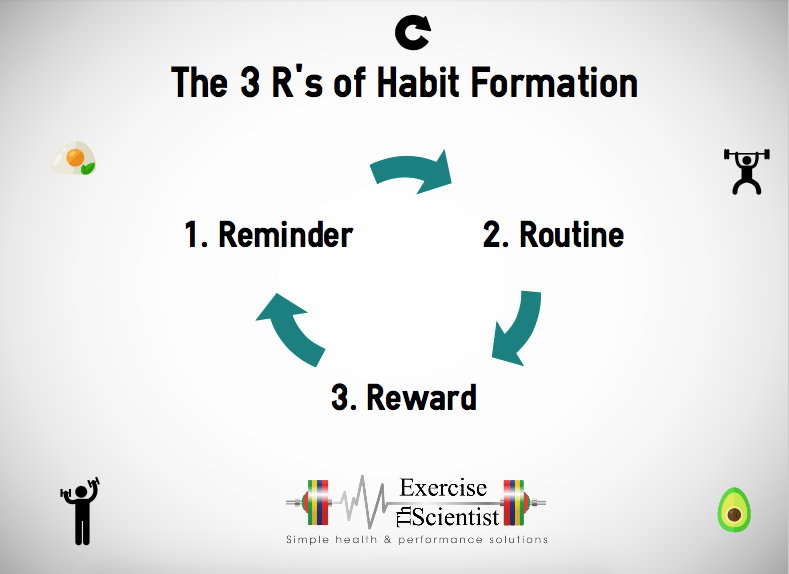
Start simple, the philosophy of our work – simple health and performance solutions. Don’t try to get to the top of the stairs in 1-step. Break it down into manageable chunks with progression. Make it so simple failure is not an option. Start with going to the gym once a week, just once. Start with planning one healthy meal a week. Swimming one length, running one block, lifting one weight. Remember the aim is to still to be doing the habit in 6-months. Establish the first step, from there think of the habit loop called the “3 r’s”
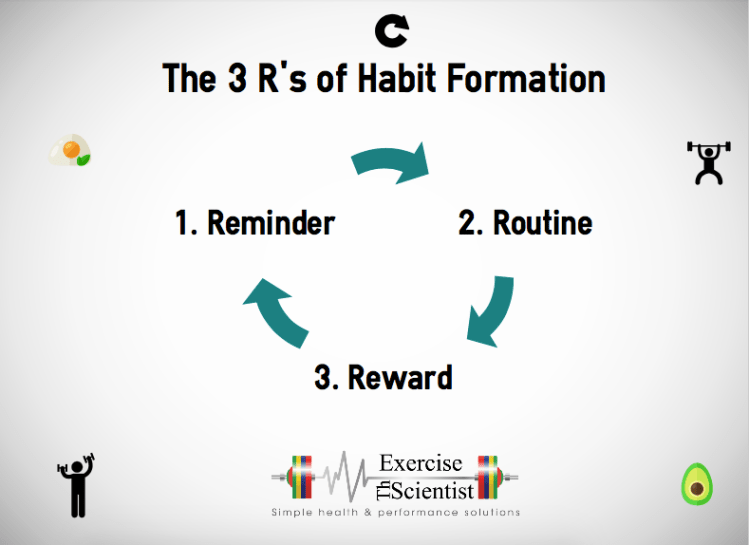
- Reminder (the trigger that initiates the behaviour)
- Routine (the behaviour itself; the action you take)
- Reward (the benefit you gain from doing the behaviour)
Reminder
 As previously stated, willpower, motivation, and memory will fail you at some point. Use reminders wherever possible. Remind yourself to set reminders. Utilise things like wall planners, whiteboards, chalkboards; apps, alarms, alarm apps or post-it notes. Stickers in frequently looked at places and I’ve even heard of lipstick on the mirror. These are just some of the methods you could use, and you need to find what works for you and may need a different approach for each habit.
Routine
What is the difference between habit and routine? The main difference is that a habit is a regular set of behaviours whereas routine is a set of habits. A habit is something you do in a regular and repeated way. It is a process that can occur subconsciously. So imagine going to the gym as the habit, perfect your routine in getting yourself there. Remove as many barriers as possible. Pack your bag the night before the gym, make your meals in advance or book classes you have to attend.
Reward
Reward the habit and not the goal. Your goal might be to lose a particular amount of weight by a given deadline. However, reward yourself on attending three spin classes in one week, swimming ten times in a month, eating breakfast every day for 20 days, whatever it is, reward the process. Merely congratulating yourself can be enough and you can do this every time you perform your habit. Some people respond better to physical rewards such as a Smoothie, coffee or shake. You might treat yourself to new shoes or eating out or a little cheat meal.
Putting it all together
What works for me is having a monthly whiteboard calendar planner. From this I can enter all my family and work events, then plan around this (simple). I work out the best nights or mornings for the gym and set alarms on my phone (reminder). The night before, I plan my session, I pack my bag, and my alarm goes off, I brush my teeth then I grab my bag and go (routine). After each session, I tick off the exercises I completed (massive satisfaction from ticking box from a list – reward).
It might take 254 days to cement a habit or as little as 18. Experiment with what works for you and persevere. Be relentless and stubborn in your approach if you believe it to be the best way and you will get there. You’re only human. We would love to hear about the ways you stick to habits or please don’t hesitate to get in touch if you would like some advice.
 theexercisescientist.com