
I speak to a lot of people who have lost their way exercising towards a particular health goal. Frequent phrases I hear are “I’m just not motivated” or “I have lost all my motivation”. I then explain to them that this is common and that everyone loses motivation. The second part isn’t so easy for everyone to grasp and that is motivation is bullsh*t. The difference between people who succeed and those who fail will never come down to isolated incidents of high motivation vs. low motivation. Motivation is highly overrated, overvalued and over emphasised in the equation for goal accomplishment in the fitness industry. Let me explain.
First, so that we are clear, we will have just one brief boring paragraph on the two types of motivation, intrinsic and extrinsic. Intrinsic motivation means that the individual’s motivational stimuli are coming from within. The individual has the desire to perform a specific task because its results are in accordance with their belief system or fulfil a desire and therefore importance is attached to it. Extrinsic motivation refers to the individual’s motivational stimuli are coming from outside. In other words, our desires to perform a task are influenced by an outside source. It’s important to understand that we are not all the same; thus each person’s motivational needs will be varied. The way we respond to both types of motivation will fluctuate person to person as well as the situation and environment, making it a complex topic with no ideal formula. Also, we do not have infinite supplies and can become immune to motivation, especially extrinsic.
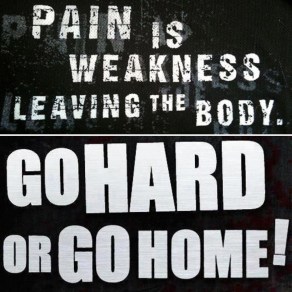
I have read so many quotes and seen so many pictures I now feel I am impervious to virtually all the little inspirational citations. They no longer do anything for me; does this mean I am unmotivated? Not necessarily. The main differences between people who stay on track tend to focus on intrinsic motivation, which is generally deeper and becomes ingrained in us. The only problem being is that it is much more difficult to intrinsically motivate someone compared to extrinsic, but it is possible. How we use our motivation is far more important than how much we have.
The same people who come to me saying they have lost motivation tend to be the same people who use motivation the wrong way. They see motivation as the fuel source when it should merely be a spark or a brief flash. Going to the gym or for a run only when you are motivated is like trying to heat up your house with a deodorant can and a lighter, it’s unsustainable (and highly dangerous for that matter). Your spark needs to be used to ignite something more powerful, a bigger system. Something that burns at a low heat for days/months/years will always beat intense flashes. Think tortoise vs. the hare. Also, have a think about the times when you are highly motivated for committing to an exercise/nutrition plan… for me, there are 2 and you may relate to this, but they are probably the least practical times to be motivated. 1) When you are lying in your bed just before you go to sleep. How many times have you said, “that’s it… tomorrow will be different, I’m starting tomorrow”. We should really jump out of bed and beast out some exercise, but we don’t, we are far too cosy. 2) When you are drunk. You might not recognise this one so much… because you’re drunk for starters, but my friends and acquaintances all know what I do. This means without fail on my now very rare nights out I will get cornered by someone wanting some exercise or nutrition advice, followed by their trials and tribulations, then a verbal agreement to train with me. I am yet to get any sober commitment from any of these people. If you are a personal trainer and want to be rich, you should set up a consultation stand in a pub and have a card machine to take payments there and then.
So if it isn’t motivation we should be pursuing then what is it that keeps us on track and in a routine? The clue is in the question. Routine is the key. Today is Monday, how many of you were highly motivated to get up and go to work this morning? If you were, then great, however for many it’s habit, discipline and you’ve done it so many times it has become routine. You might not like it, yet you do it every week. I have worked with some athletes who hate training; they hate it more than you do, they moan in the car on the way there, they moan in the changing rooms. They succeed because they turn up, they are disciplined and they have scheduled training sessions that they do not miss, even when they don’t feel like it. They understand they do not like getting up early or training in rain, sleet, snow and wind, but they also understand the bigger picture. Their motivation is the slow burning intrinsic flame, but it is ultimately discipline and commitment that is weather proof or more importantly thought proof.
Again, an all to regular phrase I hear is “it’s the thought of the gym, once I’m there I’m fine”. If this is you, then the first step is to understand this. The days where I am struggling for “motivation” I use my spark to get my shorts on; a t-shirt slogan you don’t see every day. I don’t even think about the gym or run or whatever. Just get your gear on. This strategy works for me because for a couple of reasons. 1) It breaks the whole routine into smaller, easier steps, the small victory theory. 2) The body has an anticipatory response to exercise. This means the heart rate increases before exercise even begins. Chemicals can change the heart rate by neurotransmitters, called adrenaline and noradrenaline, which are released and found in the brain. Place someone on an exercise bike and just thinking about pedalling is enough to increase their heart rate. I am convinced my brain associates wearing shorts with exercise and I get an anticipatory response. Anyone who has really needed a whizz can relate to a similar response when they see a toilet, all of a sudden you need to go a lot more. After a long day at work, it can be hard, I understand you can be hungry, tired, simply getting changed gives me a new lease of life, I feel fresher and it gives me the boost of energy needed to get to the gym.
In summary:
1. Motivation is bullshit
2. Use your motivational spark to get your shorts on
3. Turning up is 90% of the battle
4. Keep turning up
5. Turn up some more
6. Habit/routine is the first key
The only trouble is you may have already developed a bad routine that is hard to break. The next blog will be about breaking old habits and replacing them with new ones.
 theexercisescientist.com
2 thoughts on “Motivation Is Bullsh*t”